
Preview Collection
Ivubi
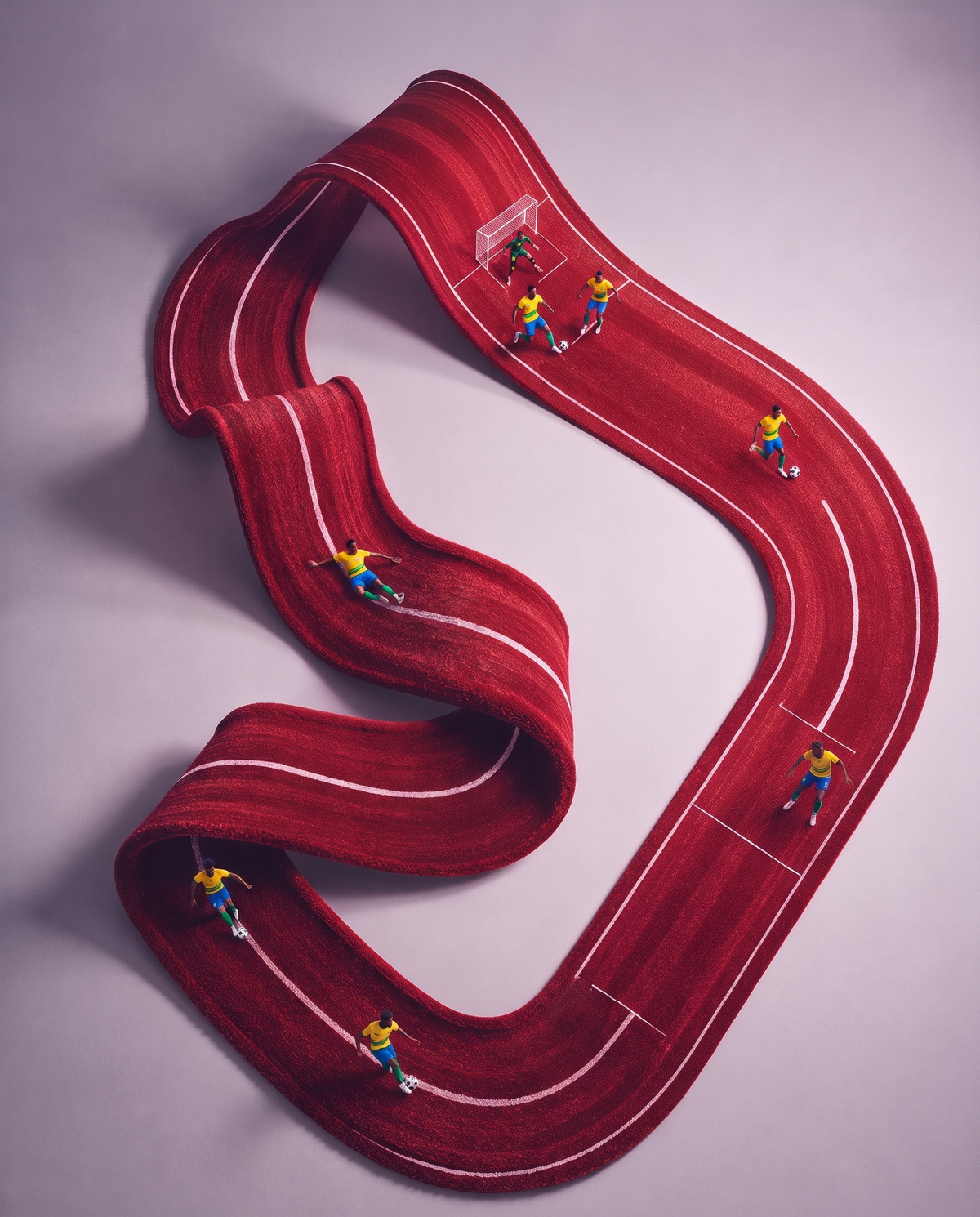
Dreams by Rusatsi
Ivubi transforms Rwanda’s national football identity into a journey of movement, courage and collective belief. Across an impossible field that rises, bends and folds through space, each player carries the instinct of one wasp, small alone, but unstoppable when moving as part of something greater.
Final print materials and sizes are currently being tested to ensure the piece meets the standard of the brand.
The Story of Ivubi
Ivubi is the Kinyarwanda word for a wasp.
Its plural, Amavubi, the wasps, is the name carried by Rwanda’s national football team. But this artwork begins with the singular.
One wasp.
One player.
One dream.
Because before a team becomes a national symbol, it begins with individuals, each carrying their own discipline, pressure, sacrifice and belief.
At first glance, the artwork presents a football match unfolding across a red field. But the pitch does not behave like an ordinary playing surface. It rises, bends, twists and loops through the composition like a living ribbon. The lines of the game continue across impossible turns, while players appear at different points along its path.
This is not a literal stadium.
It is the emotional landscape of ambition.
The field represents the journey of anyone who has ever tried to reach something larger than the circumstances in front of them. From a distance, success can appear straightforward: train, compete, score and arrive.
But real journeys rarely move in a straight line.
They rise unexpectedly.
They fold back on themselves.
They force us to continue without seeing what waits beyond the next turn.
The players do not stand together in one conventional formation. They are separated across the field, each confronting a different section of the journey.
One is climbing.
One is descending.
One is controlling the ball through a difficult turn.
Another stands close to the goal.
They may occupy different positions, but they are moving through the same story.
That is the deeper meaning of Ivubi: progress is collective even when struggle feels personal.
Every player must run their own distance.
Every generation inherits a different part of the field.
But each movement contributes to something greater than the individual making it.
The title intentionally uses the singular rather than Amavubi.
An Ivubi may appear small, yet it carries sharpness, speed, courage and the instinct to defend what belongs to it. Its real power is revealed when it is no longer understood in isolation.
One becomes many.
The individual becomes the team.
The team becomes the country.
In this work, every player is an Ivubi. Each carries personal talent, but also the weight of the shirt, the expectations of supporters and the responsibility of representing a nation.
Together, they become Amavubi.
The repeated figures can also be read as different stages of one player’s dream.
The child who first touches a football.
The young athlete who begins to believe.
The player who trains when nobody is watching.
The professional who enters the stadium carrying the hopes of millions.
They appear separately, but they may all belong to the same person, different versions of one ambition moving toward the goal.
The goal itself appears small and distant, almost fragile against the scale of the field.
That distance is deliberate.
A dream often looks smallest when the road toward it becomes overwhelming. The destination remains visible, but the journey tries to convince us that it is unreachable.
The players continue anyway.
They do not wait for the field to become flat.
They learn how to move across what they have been given.
That is where the artwork becomes larger than football.
Ivubi is about the determination to pursue excellence from a place the world may underestimate. It reflects the experience of carrying great ambition without always having a simple road toward it.
For Rwanda, football is more than a competition between two teams. It is a place where identity becomes visible, where strangers celebrate under one flag and where individual talent is transformed into collective emotion.
For a moment, the country moves as one body.
Every pass carries expectation.
Every run carries possibility.
Every goal becomes larger than the player who scored it.
The red field transforms that energy into something monumental. It is not intended to represent the colour of a real Rwandan football pitch. It is a dreamscape, a stage built from passion, pressure and national pride.
Its fabric-like surface connects the work to Rwanda beyond the football shirt. The pitch begins to resemble a ceremonial textile, as though the match is being played across something woven from culture itself.
Football and identity are no longer separate.
The players are not merely competing on behalf of Rwanda.
They are moving through Rwanda’s story.
The folds in the field create both obstacles and opportunities. What appears to be a wall from one direction becomes a path from another. A fall can become momentum. A difficult curve can create an unexpected route toward the goal.
This reflects a belief at the centre of the artwork:
The road does not need to be easy for the destination to remain possible.
Sometimes the obstacle becomes part of the technique.
Sometimes the pressure teaches balance.
Sometimes the path that appears least direct is the one that creates the most original way forward.
For Rwandans, I want Ivubi to feel like confidence.
Not confidence based only on past victories, but confidence in what our talent can still become. I want young athletes and creatives to see that representing Rwanda does not mean entering the world quietly or asking for permission to belong.
We can enter with ambition.
We can compete with imagination.
We can carry our identity without reducing it.
For those outside Rwanda, the work is an invitation to see beyond the score of a match. Behind every national team is a country imagining itself through its players, its hopes, its frustrations, its pride and its belief that the next moment could change everything.
The artwork also speaks to anyone moving through an uncertain journey.
You may not be close to the goal yet.
You may be climbing while others appear to be advancing effortlessly.
You may be standing on a part of the path that makes no sense from where you are.
But your position is not the conclusion of your story.
The field continues beyond what you can currently see.
Ivubi is therefore not simply an artwork about football.
It is about the individual courage required to become part of something greater.
It is about continuing across a path that refuses to remain flat.
It is about carrying the dream of a nation without allowing its weight to stop your movement.
And it is about understanding that greatness is rarely created by one dramatic moment.
It is built through every run, every failure, every recovery and every person who refuses to leave the field.
One player carries the dream.
Together, they give it a nation.
One Ivubi becomes Amavubi.