
Preview Collection
Mwiza
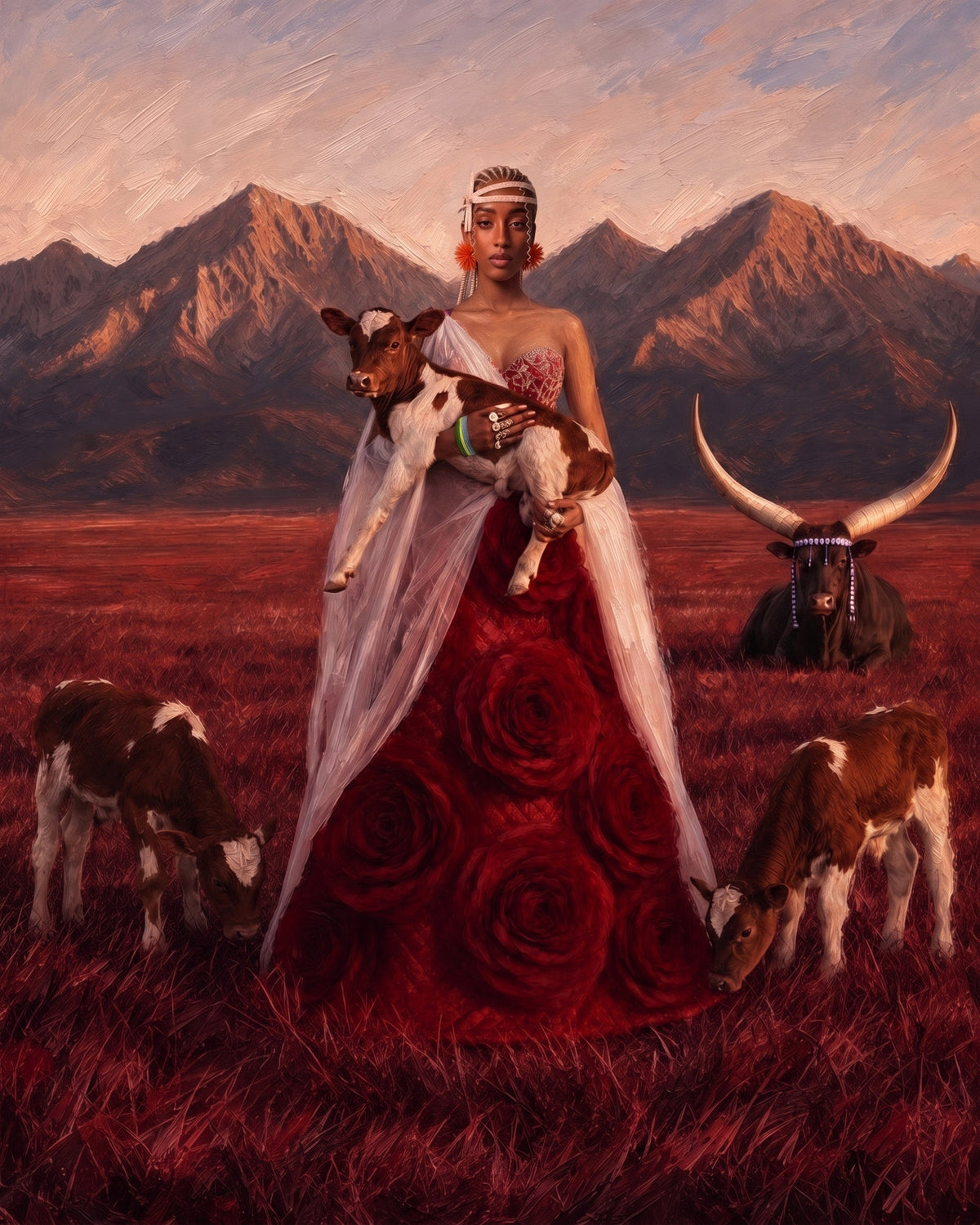
Dreams by Rusatsi
Named after the Kinyarwanda word ‘ubwiza’, meaning beauty, Mwiza explores beauty as more than appearance. Through a Rwandan woman, a royal Inyambo and its calf, the artwork becomes a story about heritage, responsibility and the future placed into the hands of a new generation.
Final print materials and sizes are currently being tested to ensure the piece meets the standard of the brand.
The Story of Mwiza
Mwiza takes its name from ubwiza, the Kinyarwanda word for beauty. But the beauty in this work is not only physical. It is the beauty of identity, dignity, inheritance and the responsibility of carrying something precious into the future.
At first glance, the artwork presents a young Rwandan woman standing in a dreamlike red landscape, holding a calf while a magnificent long-horned cow rests behind her. To someone unfamiliar with Rwanda, it may appear to be an elegant portrait. But every figure in the scene belongs to a larger story.
The cattle are Inyambo, Rwanda’s prestigious royal cows, recognised by their extraordinary horns, graceful presence and deep connection to the country’s royal history. They were not treated as ordinary livestock. Inyambo were carefully raised, adorned for important ceremonies and presented with the dignity of living symbols of status, prosperity and cultural pride.
The mature Inyambo in the background represents the legacy that already exists: generations of history, knowledge and identity that have survived long enough to reach us.
The calf in the woman’s arms represents that same legacy in its youngest form. It has not yet grown into the strength or majesty of the animal behind her. It is vulnerable, unfinished and dependent upon someone to protect it.
Standing between them is the woman.
She becomes the bridge between what Rwanda has inherited and what it may one day become.
She is not simply carrying a calf. She is carrying the future of a tradition.
Her posture is calm rather than strained. She holds the young Inyambo with tenderness, but also with certainty. The responsibility placed in her arms does not weaken her; it gives her purpose. The image suggests that preserving culture is not about holding tightly to the past out of fear. It is about caring for what came before us well enough that it can grow beyond us.
She wears my redesigned interpretation of the Umushanana, Rwanda’s traditional ceremonial dress. I did not want to reproduce it as though culture were something frozen in time. Instead, I expanded its silhouette and transformed it into something sculptural, cinematic and almost royal.
The familiar grace of the Umushanana remains, but it has entered a new visual world.
That transformation carries one of the central ideas behind Mwiza: tradition does not lose its meaning when it evolves. Culture remains alive when new generations are confident enough to honour its foundations while imagining new possibilities for it.
Around her head is the urugori, a traditional Rwandan head ornament that follows the shape of the hair. Historically, such adornment communicated more than beauty alone; it reflected dignity, womanhood and a person’s recognised status within society. In this portrait, the urugori becomes a crown, not a crown of political power, but one of cultural responsibility.
It tells us that this woman is not simply decorated by her heritage.
She has been entrusted with it.
The entire composition forms a timeline:
The mature Inyambo is the past.
The woman is the present.
The calf is the future.
None can exist meaningfully without the others.
The past provides identity.
The present decides what deserves protection.
The future reveals whether that protection was enough.
The red landscape is not intended to be a literal depiction of Rwanda. It is Rwanda transformed through imagination, a world in which its culture is allowed to appear monumental, luxurious and limitless. The colour gives the scene emotional intensity, while the mountains create the feeling that the woman is standing inside something much larger than herself.
This was important to me because African cultures are often presented to the world through narrow expectations. Their traditions may be documented, explained or preserved, but they are not always given the same visual grandeur, fantasy and creative ambition offered to other cultures.
With Mwiza, I wanted to present Rwandan identity as something worthy of the highest level of artistic imagination.
Not as a relic.
Not as a costume.
Not as something small or distant.
But as a source of beauty powerful enough to shape new worlds.
For Rwandans, I hope the artwork creates recognition and pride. I want it to remind us that our identity does not need to be minimised to become modern or globally respected. Our traditions can be the foundation of work that feels contemporary, luxurious and completely original.
For those discovering Rwanda for the first time, Mwiza is an invitation to look beyond the surface. The dress, the headpiece and the cattle are beautiful, but none of them is included merely for decoration. Each carries history. Each represents a relationship between people, culture and continuity.
Ultimately, Mwiza is about the kind of beauty that cannot be separated from meaning.
It is the beauty of knowing where you come from.
The beauty of protecting what could easily disappear.
The beauty of allowing heritage to grow rather than keeping it untouched.
And the beauty of placing the future into someone’s arms with trust.
The woman does not stand in the past, and she is not running away from it.
She stands firmly in the present, honouring what came before her while carrying it toward a world that has not yet been created.
Mwiza is not simply a portrait of a beautiful Rwandan woman. It is a portrait of beauty becoming legacy.