
Preview Collection
Kanyana
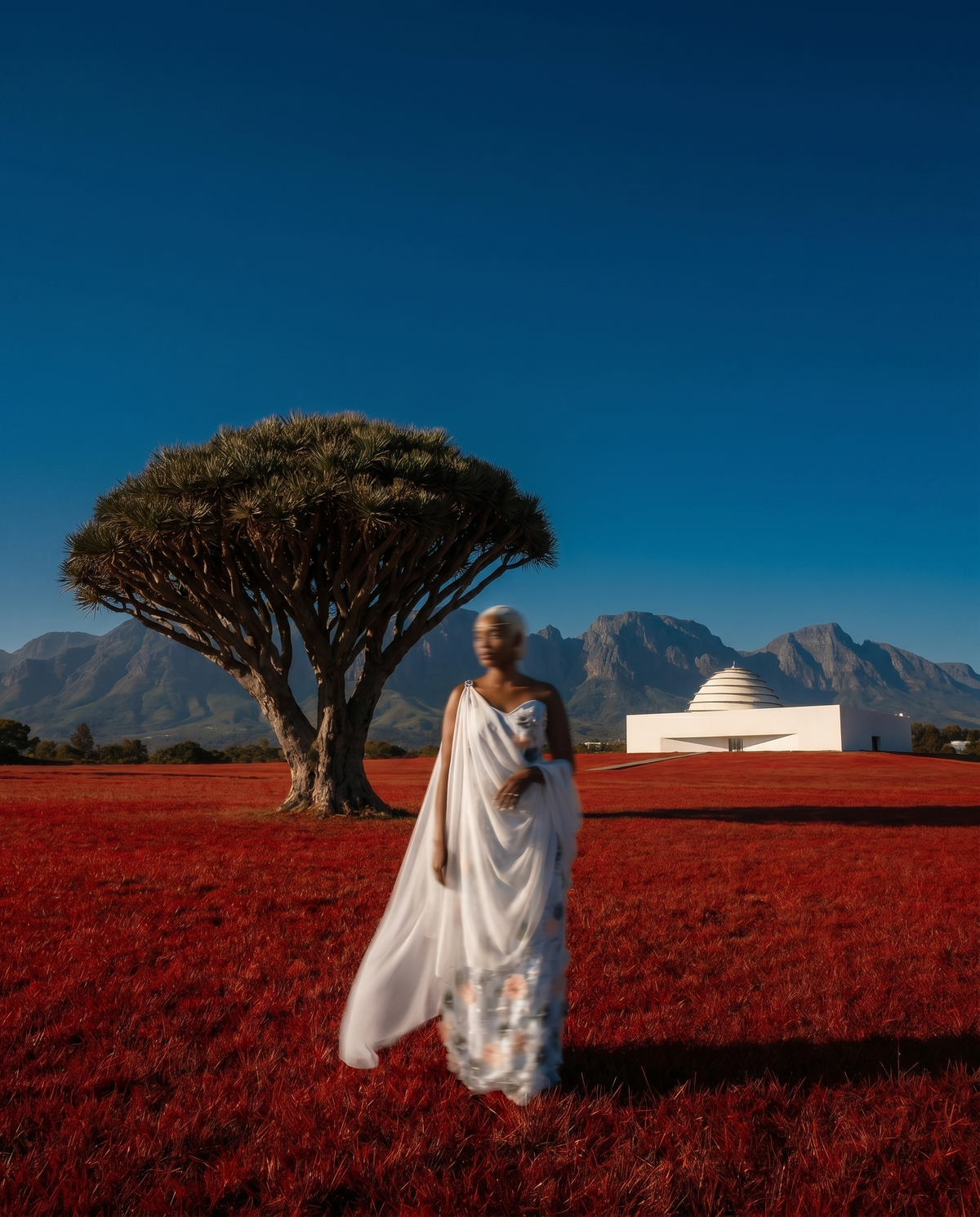
Dreams by Rusatsi
Kanyana is a portrait of a generation walking toward the future without abandoning the ground that formed it. Between an ancient tree and the architecture of modern Kigali, a young Rwandan woman moves through a dreamlike landscape, rooted in inheritance, yet refusing to remain still.
Final print materials and sizes are currently being tested to ensure the piece meets the standard of the brand.
The Story of Kanyana
Kanyana is an artwork about movement, but not escape.
A young Rwandan woman walks through a vast red landscape, dressed in flowing white. Behind her stands an old tree, wide and deeply rooted. Farther away, a white dome rises beneath the mountains: the Kigali Convention Centre, one of the most recognisable symbols of modern Rwanda.
She exists between them.
The tree and the building appear to belong to different times, yet neither is accidental.
The tree represents everything that existed before her: ancestry, memory, land and the invisible foundations from which identity grows.
The Convention Centre represents movement, ambition and the Rwanda still being imagined.
Even this modern structure carries the visual memory of Rwanda within it. Its domed form creates a conversation between ancestral design and contemporary Kigali, allowing cultural memory to remain present inside an image of progress.
This relationship lies at the centre of Kanyana:
The future does not have to erase the past in order to become new.
It can rise from it.
The woman appears slightly softened by motion, as though the artwork has captured her between one step and the next. She is visible, but not completely fixed.
This gives her the feeling of someone becoming, someone who has inherited an identity but has not allowed the world to decide its limits.
She is not standing still long enough to become a monument.
She is moving.
Her white clothing creates a powerful contrast against the red land.
White becomes clarity, possibility and quiet purpose.
Red becomes memory, intensity and the emotional weight of belonging.
She passes through both, carrying calmness across a world charged with colour.
The landscape is not intended to reproduce Rwanda literally.
It is Rwanda remembered, felt and reimagined, a country transformed into an inner world where land, identity and possibility can exist beyond realism.
The red field makes the earth feel alive.
It does not simply lie beneath her feet.
It appears to hold every step.
In this work, the name Kanyana carries the tenderness of youth and inheritance.
She represents a generation still young enough to be becoming, but already carrying the memory of an entire landscape within her.
She inherits something larger than herself.
But inheritance alone cannot determine where she will go.
She must decide what to protect, what to transform and what new path to create.
That is why her direction matters.
She is walking away from the ancient tree, but the image does not suggest rejection.
Roots do not disappear simply because the branches continue growing.
The tree remains behind her as evidence that movement and belonging are not opposites.
You can leave a place and still carry it.
You can embrace modernity without becoming disconnected.
You can imagine a different future without treating tradition as something that must be overcome.
The Convention Centre in the distance is not merely a destination.
It represents possibility: a Rwanda visible to the world, confident in its progress and capable of entering global spaces without surrendering the cultural memory that shaped it.
The woman is the bridge between those realities.
Behind her: memory.
Before her: possibility.
Within her: both.
The mountains strengthen this feeling. They seem permanent, watching over every period of change.
Trees may age.
Buildings may rise.
Generations may move across the land.
Yet the mountains remind us that identity is larger than any single moment.
Kanyana therefore becomes a portrait not only of one woman, but of Rwanda in motion.
A Rwanda that remembers.
A Rwanda that evolves.
A Rwanda that does not have to choose between cultural depth and global ambition.
For Rwandans, I want the work to feel like permission, to dream beyond what already exists without believing that moving forward means becoming less connected to home.
Our roots should not become walls around us.
They should become the strength beneath us.
For those outside Rwanda, Kanyana offers a different vision of progress.
Development is often described as leaving old things behind, as though tradition and the future cannot occupy the same world.
But Rwanda’s story reveals something more complex:
Modern identity can be built through memory rather than in opposition to it.
The past is not always a place to return to.
Sometimes, it is something that walks with us.
The woman does not turn around to prove that she remembers where she came from.
She does not need to.
The tree, the land and the mountains have already become part of the way she moves.
Her heritage is not behind her.
It is inside her.
And perhaps that is the deepest message of Kanyana:
Becoming does not require forgetting.
We are allowed to grow beyond the worlds that raised us.
We are allowed to enter unfamiliar spaces.
We are allowed to imagine lives our ancestors may never have seen.
But wherever we go, something of the first ground remains beneath every step.
Kanyana is not simply a woman walking across a red field.
She is inheritance in motion.
She is memory refusing to become a boundary.
She is a generation moving toward the future with its roots still alive beneath it.
She does not walk away from where she comes from.
She carries it toward what comes next.