
Preview Collection
Iroza
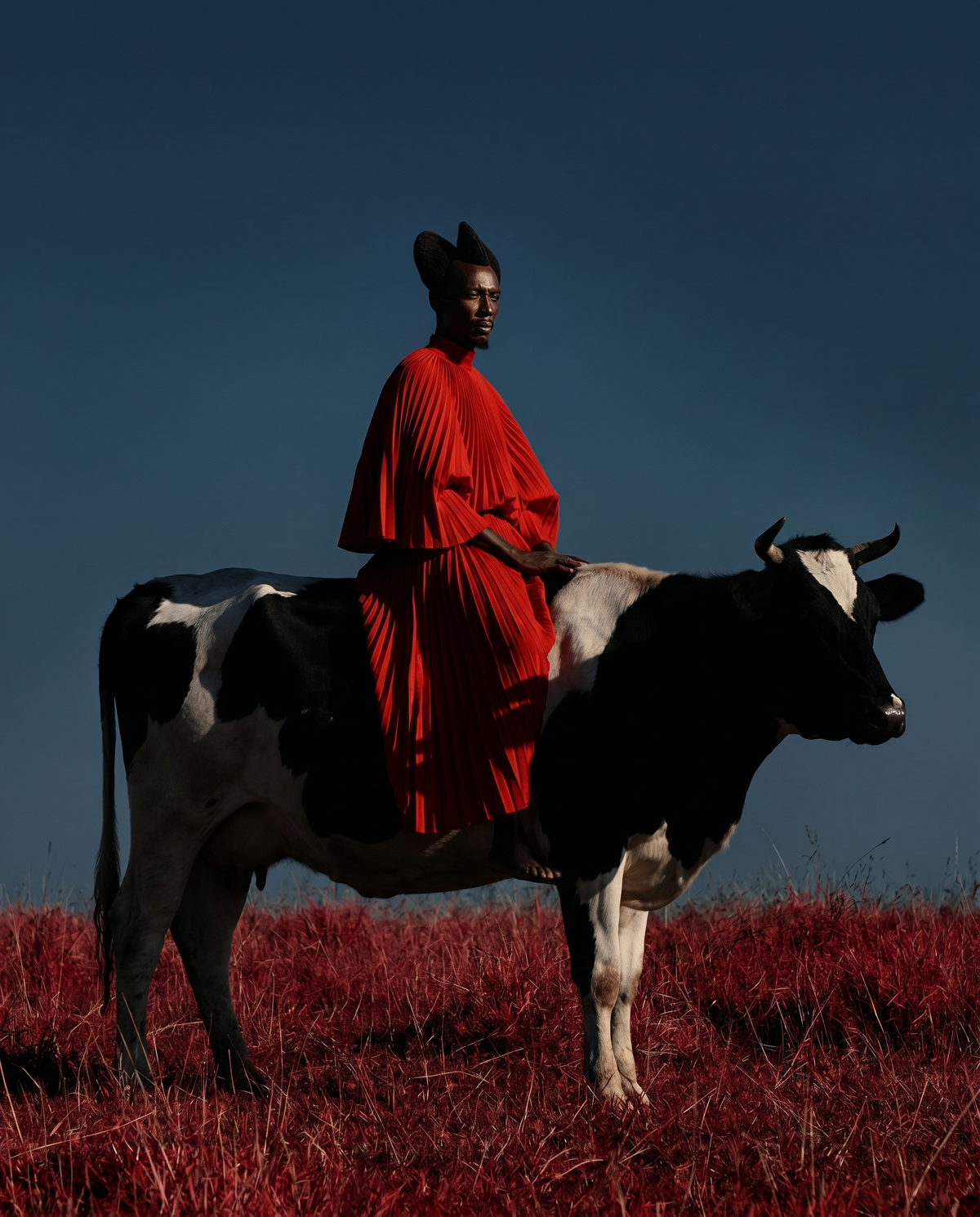
Dreams by Rusatsi
Iroza is beauty in full bloom, a portrait of elegance, pride and quiet power, where softness and strength exist in the same breath.
Final print materials and sizes are currently being tested to ensure the piece meets the standard of the brand.
The Story of Iroza
Iroza takes its name from the image of a red rose, something beautiful, striking and delicate at first glance, yet impossible to ignore. In this artwork, the rose is not shown literally. Instead, it is transformed into a living presence: a figure clothed in red, rising against a vast blue sky, poised above the land with calm authority.
At the centre of the work stands a solitary figure dressed in flowing red, seated upon a cow in a landscape washed with crimson grass. The image feels simple, but its simplicity is what gives it power. There is no unnecessary noise, no dramatic movement and no need to prove itself.
The piece stands in stillness, and through that stillness, it speaks.
For me, Iroza is about a kind of beauty that does not beg to be seen.
It already knows its worth.
The red in the artwork carries the soul of the entire piece. It calls to mind the rose, not only as a symbol of beauty, but as a symbol of emotion, presence and depth.
A rose is soft, yet unforgettable.
Fragile in appearance, yet powerful in effect.
That same tension lives in this image. The figure appears graceful and composed, but there is also strength in the posture, certainty in the gaze and dignity in the silence.
The cow beneath the figure is equally important. Within Rwanda’s cultural memory, cattle carry associations of value, care, prestige, identity and connection to the land.
Here, the cow grounds the image in heritage, while the figure transforms that heritage into something elevated and almost dreamlike.
That contrast is central to the meaning of the work.
The image lives between earth and elegance.
Between tradition and reinvention.
Between softness and power.
The red garment feels almost sculptural, like petals gathered into form. It turns the body into something monumental, as though the figure is not simply wearing colour, but emerging from it.
Even the landscape seems to respond, with the red grass echoing the same emotional language.
It is as though the figure and the land are blooming together.
This is why the title Iroza matters so much.
A rose does not need to be loud to dominate a garden.
Its beauty is enough.
Its presence is enough.
Its form is enough.
That is the spirit of this piece.
It is about the confidence of taking up space without force.
It is about being deeply rooted, yet fully refined.
It is about carrying beauty not as decoration, but as identity.
For me, Iroza is also a statement about how African identity, and Rwandan identity in particular, can be presented.
Too often, beauty from our part of the world is reduced, simplified or made to feel ordinary. I want this work to do the opposite.
I want it to present Blackness, culture and presence at the highest visual level: cinematic, elegant, timeless and unforgettable.
The figure does not appear as someone being observed.
They appear as someone fully owning the space they occupy.
That changes everything.
The work becomes less about appearance alone and more about self-possession. It asks the viewer to recognise a beauty that is not fragile, passive or temporary.
This is beauty as confidence.
Beauty as command.
Beauty as legacy.
For Rwandans, I hope Iroza feels like pride made visible. A reminder that our stories, our aesthetics and our presence deserve to be seen with grandeur and imagination.
I want it to feel like a work that honours where we come from while carrying it into a more elevated, artistic and international visual language.
For those discovering Rwanda through this artwork, I want the piece to remain universal in emotion even when its deeper roots are cultural.
Most people understand what a rose represents:
Beauty.
Value.
Tenderness.
Admiration.
Iroza takes that familiar symbol and gives it a new body, a new landscape and a new cultural voice.
Ultimately, Iroza is not simply a portrait.
It is a bloom.
A declaration.
A quiet monument to beauty that knows itself.
It reminds us that the most powerful presence in the room is not always the loudest one.
Sometimes, it is the one that sits in stillness,
and makes everything around it feel more alive.