
Preview Collection
Inzozi
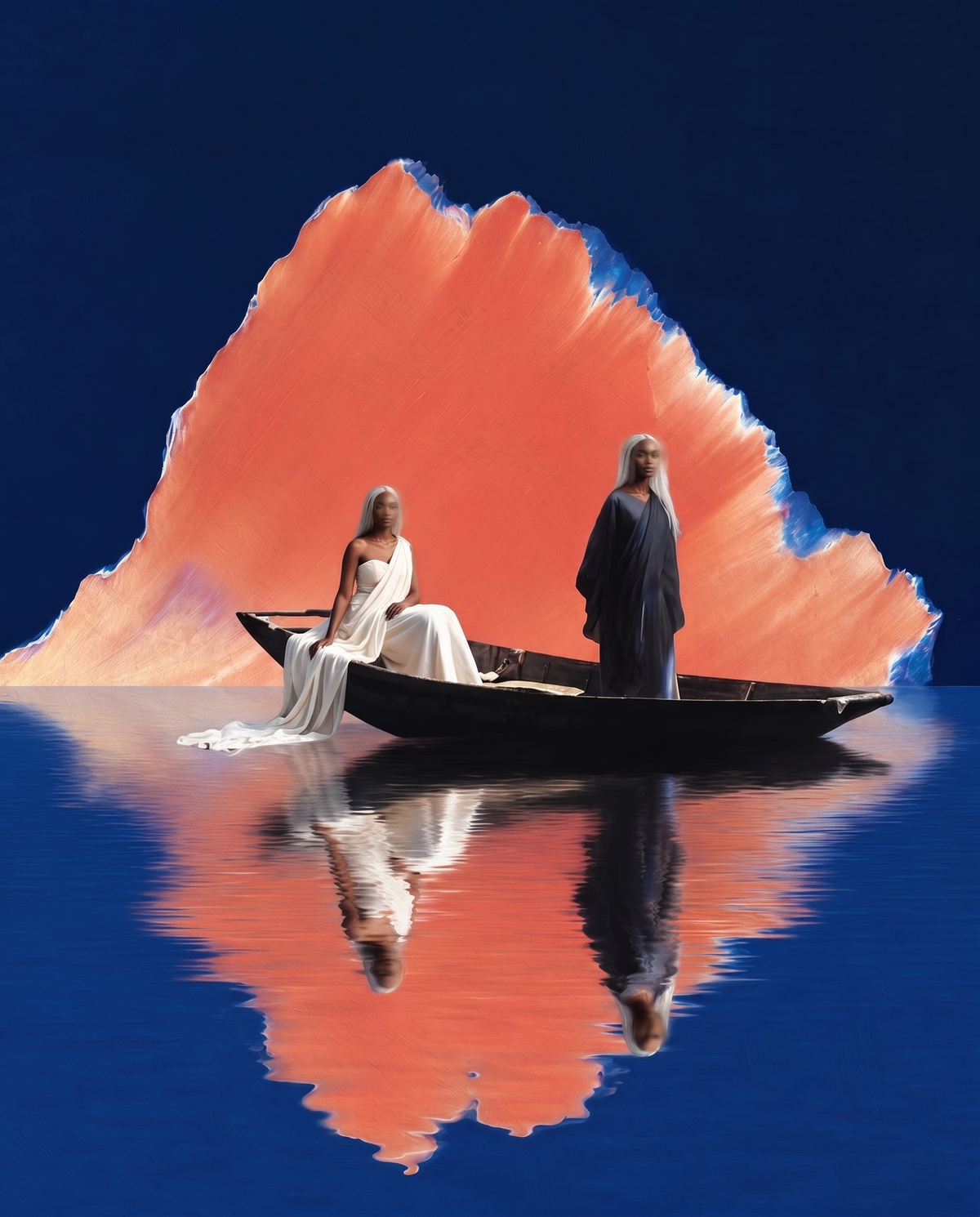
Dreams by Rusatsi
Inzozi is a passage between the life we know and the life we imagine. Two women travel across still water beneath a glowing horizon, while their reflections reveal another world below, a meditation on memory, possibility and the quiet courage required to follow a dream.
Final print materials and sizes are currently being tested to ensure the piece meets the standard of the brand.
The Story of Inzozi
Inzozi means dreams.
Not the dreams that disappear when morning comes, but the ones that remain with us, the visions that quietly shape who we become long before we understand where they are leading us.
At the centre of the artwork, two women travel together in a small dark boat. One is seated in white, calm and luminous. The other stands in black, facing the distance with a quiet certainty. Behind them rises a vast coral form, part mountain, part flame, part opening into another world.
Everything around them appears still.
The water does not resist them.
The horizon does not explain itself.
The destination remains unseen.
Yet they continue.
The two women can be understood as separate travellers, but they may also represent two parts of the same person.
The woman in white carries memory, the self shaped by everything already lived. Her presence is soft, reflective and connected to what has been. She sits close to the water, almost touching the boundary between the visible world and the one reflected beneath it.
The woman in black represents possibility, the self that has not yet fully arrived. She stands upright, looking beyond the frame as though she can sense a future that remains invisible to everyone else.
One remembers.
One imagines.
Together, they move forward.
This relationship lies at the heart of Inzozi: every dream is created between who we have been and who we believe we might become.
We do not begin again as empty people. We carry memories, fears, identities, losses and hopes into every new journey. The past does not remain behind us; it enters the boat with us. But it does not have to decide the direction.
The boat becomes a vessel of transformation.
It is small compared with the landscape surrounding it, yet it carries everything necessary for the journey. It does not appear grand or powerful. It moves through vulnerability, trusting the water beneath it and the vision ahead.
That contrast is intentional.
Dreams often begin in forms that appear too small for their destination.
A private idea.
A childhood memory.
A sketch made after work.
A belief no one else can yet see.
From the outside, these beginnings may seem fragile. But something does not need to look powerful in order to carry us toward a powerful future.
The glowing form behind the women feels both solid and unreal. Its coral colour burns against the deep blue world, like a piece of imagination made physical. It could be a mountain, an island, a sunrise or the remains of a world they have already passed through.
Its meaning is deliberately open.
Dreams rarely arrive as clear instructions. They appear first as feelings, fragments and images, something beautiful enough to call us forward, but uncertain enough to require faith.
The women are not given a visible map.
They are guided by something deeper.
The water beneath them creates another important dimension. Their bodies are reflected below the boat, but the reflection does not feel like a simple copy. It resembles a second world: one that exists beneath the surface, shaped by emotion, memory and imagination.
Above the water is the life others can see.
Below it is everything carried privately.
The doubts no one hears.
The sacrifices no one witnesses.
The future imagined before it becomes real.
The reflection reminds us that every visible journey is accompanied by an invisible one.
A person may appear still while fighting to become someone new.
They may appear certain while carrying fear.
They may appear to be moving slowly while crossing an entire inner world.
In Inzozi, the reflection is as important as the figures themselves because dreams exist twice: first within us, and later, when courage, discipline and time allow, within the world.
The contrast between white and black does not represent good and bad. Instead, it creates balance.
White holds openness, remembrance and surrender.
Black holds mystery, strength and the unknown.
Neither woman is complete without the other.
A dream needs tenderness, but it also needs determination.
It needs imagination, but it also needs discipline.
It needs the ability to honour where we come from, while refusing to believe that the past is the limit of what we can become.
The stillness of the scene is also important. There is no storm, no visible struggle and no dramatic wave. The artwork captures a quieter form of courage: continuing even when progress cannot be measured.
Not every meaningful journey looks heroic from the outside.
Sometimes, courage is simply remaining committed when nothing appears to be changing.
Sometimes, it is trusting a direction before there is proof.
Sometimes, it is protecting a dream from the noise of people who cannot yet understand it.
The women do not appear lost.
They appear willing to travel without certainty.
That is different.
Being lost means having no direction. Dreaming means following a direction that may not yet exist for anyone else.
For Rwandans, I want Inzozi to speak to the power of imagination within us. Our identity is deeply connected to memory and history, but we are also a people capable of creating futures that have never existed before. We do not have to choose between honouring where we come from and imagining something larger.
We can carry both in the same boat.
For anyone encountering the work, regardless of where they come from, Inzozi is a reminder that the person you are today does not have to be the final version of you.
There may already be another self standing quietly within you, looking toward a horizon you have been afraid to follow.
The distance between your present life and that imagined future may feel immense.
But every journey begins before certainty.
Before recognition.
Before success.
Before anyone else understands.
It begins the moment you decide that what you see within yourself is worth moving toward.
Inzozi is not simply an image of two women crossing water.
It is a portrait of becoming.
It is the conversation between memory and possibility.
It is the invisible moment when an imagined life begins to feel real enough to pursue.
The women do not know exactly what waits beyond the horizon.
They only know that remaining where they were is no longer enough.
One carries the life that shaped them.
The other carries the life still waiting to be created.
Together, they follow the dream.