
Preview Collection
Umutesi
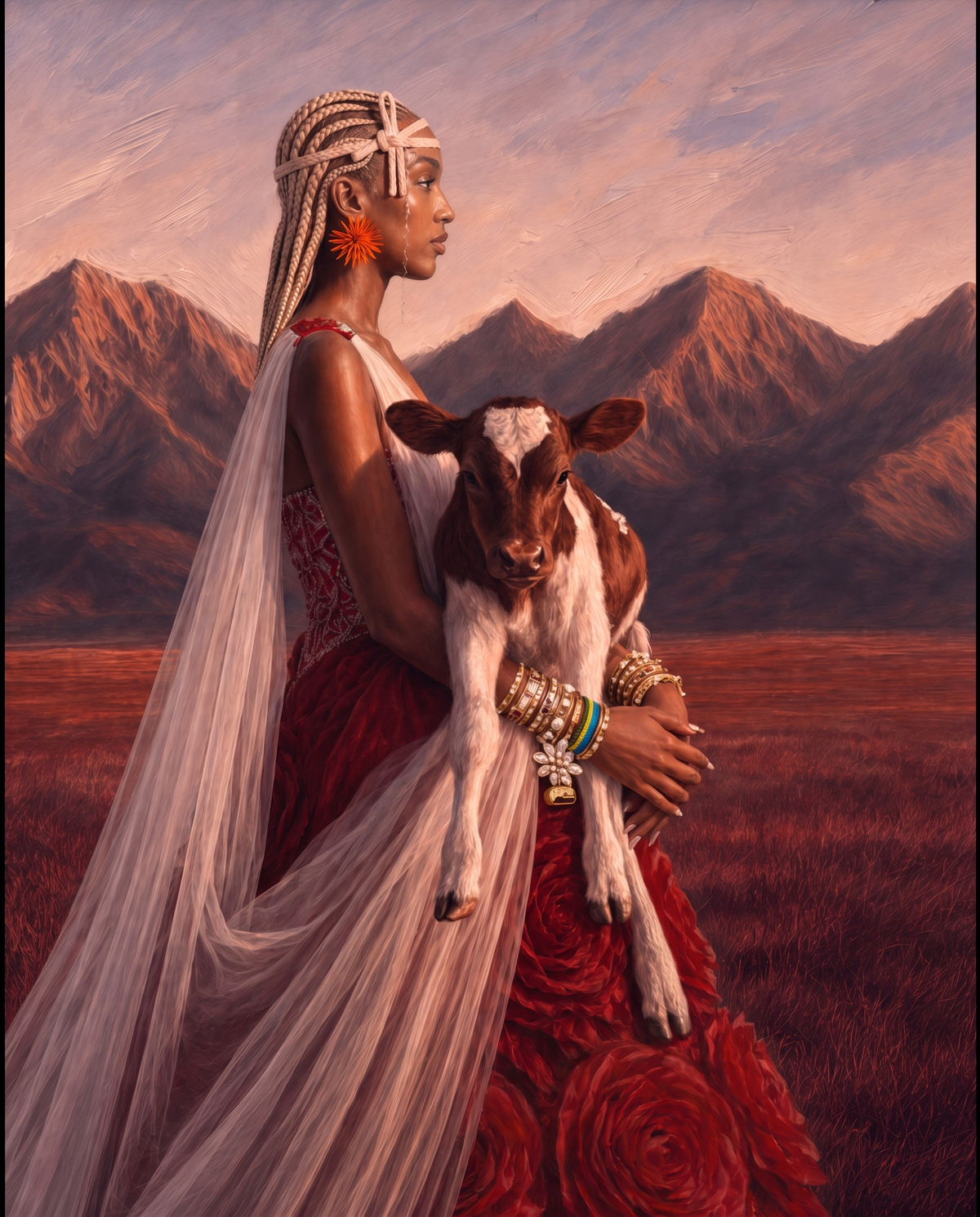
Dreams by Rusatsi
Umutesi is a portrait of the love that makes us protect what we inherit. A Rwandan woman holds a young Inyambo close to her body, not as something to display, but as something precious, vulnerable and deeply cherished.
Final print materials and sizes are currently being tested to ensure the piece meets the standard of the brand.
The Story of Umutesi
Umutesi is a portrait of the love that makes us protect what we inherit. A Rwandan woman holds a young Inyambo close to her body, not as something to display, but as something precious, vulnerable and deeply cherished.
The name Umutesi can be understood as “the cherished one”, someone held with exceptional love and tenderness. In this work, that name belongs not only to the woman or the calf, but to everything carried within the image: home, identity, memory and the parts of ourselves we refuse to let disappear.
At first glance, the scene is quiet. A young Rwandan woman stands in profile beneath a soft, dreamlike sky. Mountains rise behind her, while an Inyambo calf rests securely in her arms.
For someone unfamiliar with Rwanda, the animal may appear to be an ordinary calf. But it belongs to the lineage of the Inyambo, Rwanda’s prestigious royal cattle, recognised for their extraordinary horns, graceful presence and place within the country’s royal traditions.
In Mwiza, a mature Inyambo stands behind the woman as a visible symbol of the history that came before her. In Umutesi, that commanding figure is absent. What remains is the young calf and the woman entrusted with its care.
The story becomes more intimate.
It is no longer only about the importance of heritage.
It is about the emotional bond that makes heritage worth preserving.
The woman does not present the calf proudly toward the viewer. She draws it close to her body. Her arms surround it with a tenderness that feels instinctive, as though she understands that some things survive not because they are powerful, but because someone chose to protect them while they were still fragile.
The calf represents a legacy in its earliest form.
It has not yet grown the immense horns or stately presence associated with a mature Inyambo. Its future majesty exists only as possibility. For now, it depends entirely on the care it receives.
That vulnerability is central to the artwork.
Every culture begins each new generation in the same way: unfinished, impressionable and placed into someone else’s hands. A tradition may carry centuries of history, but it can still disappear when no one teaches it, values it or finds a new way to keep it alive.
What we inherit is never guaranteed to survive us.
It survives because we cherish it.
The woman’s side profile strengthens this feeling. She is not looking at us or asking for our recognition. Her attention seems to exist somewhere beyond the frame, as though she is remembering a place, a person or a life that cannot be fully seen.
This gives Umutesi the feeling of longing, not longing as emptiness, but as proof of connection.
We long for what has shaped us.
We protect what we cannot imagine losing.
We hold close what distance has taught us to value.
The mountains behind her become more than landscape. They feel like home remembered from afar: present enough to shape her, yet distant enough to become almost dreamlike.
The red earth is not a literal depiction of Rwanda. It is an emotional landscape, a Rwanda transformed by memory and imagination. The colours are intensified because memory rarely returns to us exactly as reality. It becomes warmer, larger and more meaningful with time.
She wears my redesigned interpretation of the Umushanana, Rwanda’s traditional ceremonial dress. Its flowing fabric remains connected to the elegance of the original garment, but its form has been expanded into something sculptural and cinematic.
The redesign reflects my belief that honouring culture does not mean repeating it without change.
Tradition is not weakened by imagination. It becomes stronger when a new generation understands it deeply enough to carry it into places it has never been before.
The fabric moves around the woman almost like a protective force, surrounding both her and the calf. It connects them visually, making it difficult to see where the responsibility of one ends and the vulnerability of the other begins.
Around her head is the urugori, a traditional Rwandan adornment associated with womanhood, dignity and social identity. In this portrait, it is not included simply for decoration. It frames her as someone who carries value, memory and responsibility.
But unlike a conventional crown, it does not place her above what she holds.
Her importance comes from her capacity to care for it.
That is the deeper power of Umutesi. It challenges the idea that strength must always be loud, commanding or physically dominant.
Here, strength appears as tenderness.
It is the patience to protect something whose full potential may only be seen by those who come after you. It is the courage to remain connected to your identity, even when the world encourages you to become disconnected from it. It is the decision to treat what you inherited not as an obligation, but as something worthy of love.
While Mwiza explores beauty becoming legacy, Umutesi reveals the love beneath that legacy.
Before culture can be carried forward, it must first be cherished.
Before history can become powerful, someone must believe it is worth remembering.
Before a young Inyambo can grow into the majesty of its lineage, someone must hold it through the years when that majesty cannot yet be seen.
For Rwandans, I hope this work feels like a reminder that our relationship with culture does not need to exist only through ceremony or history. It can be personal, emotional and alive. Our traditions are not distant objects belonging to another time. They are things we can love, reinterpret and carry with us wherever we go.
For those discovering Rwanda through the artwork, Umutesi offers a quieter introduction. The cultural symbols matter, but the emotion connecting them is universal.
Most people know what it means to cherish something.
A memory.
A place.
A person.
A language.
A dream.
A part of themselves they are afraid the world might make them forget.
The calf becomes a symbol for all of these things: whatever remains delicate within us, whatever connects us to home and whatever we hope will survive long enough to grow into its full strength.
Umutesi is therefore not simply a portrait of a woman holding an animal.
It is a portrait of devotion.
It is about the quiet decisions through which identity survives.
It is about holding the future before the future understands what it carries.
And it is about recognising that the things we love most deeply often become the things we fight hardest to preserve.
She does not hold the calf because it is already powerful.
She holds it because she can see the power it may one day become.
And perhaps that is what it truly means to cherish something: to recognise its value before the rest of the world has learned how to see it.